If you need to reapply sunscreen over makeup, it can be done without completely ruining your base, but the technique matters. The most practical options are usually powder, mist, stick, or a liquid sunscreen pressed on gently with a sponge or puff. None of them is perfect in every situation, so the goal is to balance decent coverage with a finish you can actually live with during the day.
Daily sun protection is part of a wider routine, especially in a hot, bright climate where commuting, lunch breaks and afternoon errands can add up. If you want the basics of a full routine as well, see our skincare guide for Malaysians.
Yes, you can reapply sunscreen over makeup by blotting excess oil or sweat first, then choosing a format that suits your skin and makeup. Mists, powders, sticks and sponge-applied liquids are all common options. The best choice depends on how much makeup you’re wearing, how oily your skin gets, and whether you expect brief incidental sun exposure or more time outdoors.
- Blot first so sunscreen does not slide over oil or sweat
- Choose a format that suits your base and skin type
- Press or mist gently instead of rubbing
- Focus on exposed areas such as the forehead, nose and cheeks
Can you reapply sunscreen over makeup?
Yes, but it usually looks better when you accept that midday SPF touch-ups are not exactly the same as your first morning application. A fresh layer of sunscreen on bare skin is usually easier to apply evenly. Once foundation, concealer and powder are in place, the challenge becomes getting enough product on the skin without smearing everything around.
That does not mean reapplication is pointless. If you are out for part of the day, sitting near strong daylight, walking between buildings, driving, or spending time outdoors, topping up protection still matters. Many people skip it simply because they assume it will destroy their makeup. In reality, some formats are much easier to work with than others.
The tricky part is that makeup-friendly sunscreen formats often involve trade-offs. Some are very convenient but harder to apply generously and evenly. Others may give better coverage but take more time and more careful technique. It helps to think in terms of what is realistic for your day rather than looking for one perfect method.
How to reapply sunscreen over makeup in 5 simple steps
- Blot excess oil and sweat first. Use blotting paper, a tissue or oil-absorbing sheet to lift shine, sweat and surface moisture.
- Pick the right format. Powder, mist, stick or liquid pressed in with a sponge all work differently.
- Apply gently. Avoid rubbing. Press, pat or mist evenly depending on the product type.
- Prioritise exposed areas. Focus on the forehead, cheeks, nose, chin and any area that gets direct sun.
- Touch up makeup only if needed. A little powder, concealer or blush can tidy the finish after sunscreen.
Step 1: Blot excess oil and sweat first
This is one step people often skip, and it makes a big difference. If your skin is sweaty or oily, sunscreen can catch unevenly, separate your foundation or turn patchy. In Malaysia’s humid weather, even a short walk outdoors can leave a layer of moisture on the skin.
Blot gently rather than wiping. You want to remove excess oil and sweat, not lift your base. If you wear a lot of powder, go lightly so the surface does not become overly dry or flaky before reapplication.
Step 2: Choose the right sunscreen format for your makeup
The best way to reapply sunscreen over makeup depends on what is already on your face. A sheer skin tint behaves differently from a full-coverage matte base. If you are wearing minimal makeup, a liquid sunscreen pressed in with a sponge may be manageable. If your base is long-wear and carefully set, a mist, stick or powder may be less disruptive.
Skin type matters too. Oily skin may prefer powder or a lighter mist. Drier skin may find powder emphasises texture and may prefer a stick or gentle liquid application instead.
Step 3: Apply gently instead of rubbing
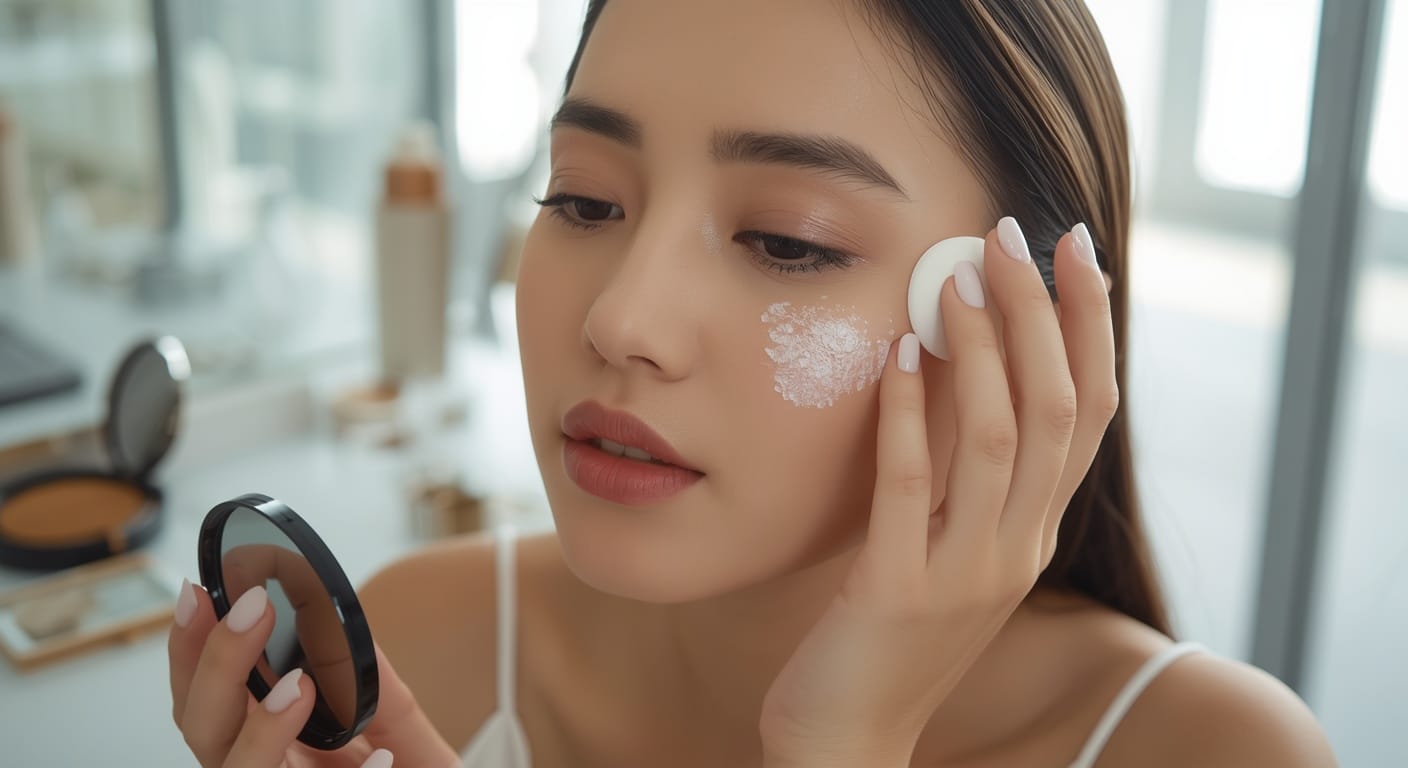
Rubbing is what usually ruins makeup. With sticks, glide lightly, then tap the product in with clean fingers or a sponge if needed. With liquid sunscreen, dispense a small amount onto a sponge or cushion puff and press it onto the skin. With mists, spray according to the product directions and allow it to settle without immediately rubbing it through.
The idea is to build coverage with as little friction as possible.
Step 4: Focus on high-exposure areas like the cheeks, nose and forehead
If you are trying to touch up quickly, start with the areas that usually catch the most sun. The forehead, bridge of the nose, cheeks and chin are common priorities. Do not forget the temples if they are exposed, and the neck if it is not covered by clothing.
If you wear sunglasses, hat bands or a face covering for part of the day, those areas may still need attention once they are uncovered again.
Step 5: Touch up your makeup only if needed
After sunscreen reapplication, your base may look slightly dewier, softer or less defined than it did in the morning. That is normal. You may not need to fix anything at all. If you do, keep it light: a bit of pressed powder, concealer around the nose, or a quick blush touch-up is often enough.
Trying to fully rebuild your makeup every time you reapply sunscreen can make the whole process feel too fussy to keep up with.
Best sunscreen formats to use over makeup
No format is automatically the best for everyone. The right choice depends on how much makeup you are wearing, how much time you have, and how even you can realistically apply it during the day.
| Format | What it does well | Possible downside | Best for |
|---|---|---|---|
| Powder sunscreen | Convenient, portable, helps reduce shine | Can be harder to apply evenly or generously | Oily skin, quick touch-ups, matte finishes |
| Sunscreen mist or spray | Fast, low-contact, usually less disruptive to makeup | Coverage can be inconsistent if applied too lightly | Light to medium makeup, on-the-go reapplication |
| Sunscreen stick | Good for targeted areas, travel-friendly, less messy | May drag on some base products if used too firmly | Nose, cheeks, forehead, handbag touch-ups |
| Liquid sunscreen with sponge | Often gives more thorough coverage than lighter touch-up formats | Takes more technique and may affect the finish more | Minimal makeup days or more patient reapplication |
Powder sunscreen: convenient for oily skin and shine control
Powder sunscreen over makeup is popular because it feels easy and tidy. It can be especially appealing if your skin gets shiny by midday or your makeup already includes powder products. It also suits people who dislike the feel of a heavier product layered on top.
The trade-off is that it may be harder to achieve even, substantial coverage compared with a traditional cream or lotion texture. It works best if you treat it as a practical touch-up option rather than assuming a few quick swipes automatically solve everything.
Sunscreen mist or spray: fast touch-ups with light disruption
Spray sunscreen over makeup is often the least fiddly method, especially when you are out and about. It does not require much touching of the face, so it can preserve foundation better than some other formats.
Its weakness is that easy application can tempt people to use too little. A very light spritz may not give the kind of coverage you think it does. If you choose this method, be deliberate and even in your application, and follow the product directions carefully.
Sunscreen stick: targeted reapplication for small areas
Sticks are useful when you want more control. They are handy for the tops of the cheeks, nose and forehead, and they are generally easy to carry. They can also be less messy than liquids if you are reapplying in the car before a meeting or during a quick bathroom break.
The main thing to watch is pressure. If you drag a stick firmly over a full-coverage base, you may shift the makeup underneath. Light passes and gentle tapping can help keep the finish neater.
Liquid sunscreen pressed in with a sponge: better coverage but more technique required
If your priority is getting a more substantial sunscreen layer back onto the skin, a liquid sunscreen applied with a sponge or cushion puff can be a sensible option. Dispense a small amount, then press rather than rub.
This method often works best on lighter makeup days, or when you are willing to accept that your finish may change slightly. It is not always the quickest choice, but it can be practical if you want a more controlled reapplication than a mist or powder allows.
Which method works best for different skin types and makeup looks?
Oily or combination skin
If you get shiny through the T-zone, blotting first is especially important. Powder sunscreen may feel the most comfortable, and mists can also work if they are not too heavy for your preferences. Sticks can work well on targeted areas, but use a light hand if your foundation tends to break apart around oilier zones.
Dry or dehydrated skin
Powders can sometimes catch on dry patches or make the skin look flat. A mist, stick or carefully pressed liquid sunscreen may sit better. If your makeup already looks tight or flaky by afternoon, choose a method that adds less visible texture.
Full-glam or long-wear base makeup
If you have spent time perfecting a fuller base, low-friction methods usually make more sense. A mist is often the easiest starting point. A stick can also work if you focus on high points of the face and avoid too much dragging. Liquid sunscreen is possible, but it usually has the highest chance of changing the finish.
Minimal makeup or skin tint days
These are the easiest days for sunscreen reapplication over makeup. You have more flexibility to use a stick or liquid sunscreen with a sponge because the base underneath is less heavy and less structured. If you only wear concealer or a tinted moisturiser, you may find that a gentle pressed-on liquid gives the most reassuring touch-up.
Common mistakes when you reapply sunscreen over makeup
Applying too little product
This is probably the biggest issue with makeup-friendly reapplication. Because people want to preserve their base, they often go in too lightly. A delicate dusting or quick mist may feel convenient, but convenience and even coverage are not the same thing.
Rubbing and lifting the base
If you rub sunscreen in as though your skin is bare, foundation can separate, pill or move. Pressing, patting and gliding lightly are usually safer than rubbing.
Reapplying on sweaty skin without blotting
Sunscreen sits better on skin that is not slick with sweat and oil. Blot first, especially after commuting, walking outdoors or spending time in non-air-conditioned spaces.
Assuming one format suits every situation
A powder might be useful on a humid workday, while a liquid-and-sponge approach may work better before an outdoor event. You do not need one universal method. You need a method you will actually use in the situation you are in.
How often should you reapply sunscreen in Malaysia?
There is no single answer that fits every routine. If you spend most of the day indoors and away from direct sun, you may not need midday reapplication in the same way as someone who commutes, eats lunch outside, drives frequently, or works outdoors. Window exposure, walking between locations and time spent running errands all make a difference.
Malaysia’s heat and humidity can also affect how sunscreen and makeup wear through the day. Sweat, oil and frequent face-touching can reduce how fresh your morning application feels. If you know you will be outdoors for stretches of time, it makes sense to plan a practical reapplication method in advance rather than hoping your morning layer will still look and feel the same hours later.
Tips to make sunscreen reapplication easier during the day
- Keep blotting paper or tissues on hand. This helps prepare the skin quickly before touch-ups.
- Use a mirror if you can. Even quick sunscreen reapplication tends to look better when you can see where the product is landing.
- Work in sections. Forehead first, then cheeks, nose and chin can be easier than rushing the whole face at once.
- Plan around your day. Commuting, lunch breaks, outdoor meetings and errands are common times when touch-ups are most useful.
- Keep makeup touch-ups minimal. A light tidy-up is easier than trying to fully restart your base.
When sunscreen over makeup may not be enough
Touching up sunscreen without ruining makeup is useful, but it has limits. If you expect long outdoor exposure, beach time, sports, hiking or extended midday sun, makeup-friendly reapplication methods may not be the only thing you rely on. In those situations, other sun-protection habits still help, such as seeking shade where possible, wearing sunglasses, and using a hat or other protective clothing when practical.
If your skin is reacting badly to sunscreen reapplication, or if a product stings, causes marked irritation or repeatedly triggers breakouts, it may be worth discussing your options with a pharmacist, doctor or dermatologist. The most elegant daytime SPF method is not very helpful if your skin cannot tolerate it comfortably.
Frequently Asked Questions
Can I apply liquid sunscreen over foundation without ruining it?
Yes, it can be done more neatly if you press it on with a sponge or puff instead of rubbing it in with your hands. The finish may still change slightly, especially with fuller coverage foundation, but gentle pressing usually causes less disruption.
Is powder sunscreen enough for reapplication?
It can be a practical touch-up option, especially for oily skin or shine control, but even coverage and generous application can be harder to achieve than with traditional lotion textures. It is convenient, though not automatically the strongest option in every situation.
How often should I reapply sunscreen if I work indoors?
That depends on how much sun exposure you actually get during the day. If you mainly stay indoors but commute, sit near bright windows or go outside for lunch or errands, a touch-up may still be worth considering. The more direct or repeated exposure you get, the more relevant reapplication becomes.
What is the least messy way to reapply sunscreen over makeup?
Mists and powders are often the least messy, and sticks can also be convenient for quick targeted touch-ups. The trade-off is that the easiest method is not always the one that gives the most even or substantial coverage.
Should I blot my face before reapplying sunscreen?
Yes. Blotting excess oil and sweat can help sunscreen sit more evenly on the skin and can reduce patchiness, slipping and unnecessary disturbance to your makeup.
A practical way to make it work
If you regularly wear makeup during the day, the best sunscreen reapplication method is usually the one you can do consistently without dreading the process. Blot first, choose a suitable format, apply gently, and accept that a small makeup touch-up may be part of the routine. In real life, a practical midday top-up is often better than skipping reapplication entirely because it feels too inconvenient.