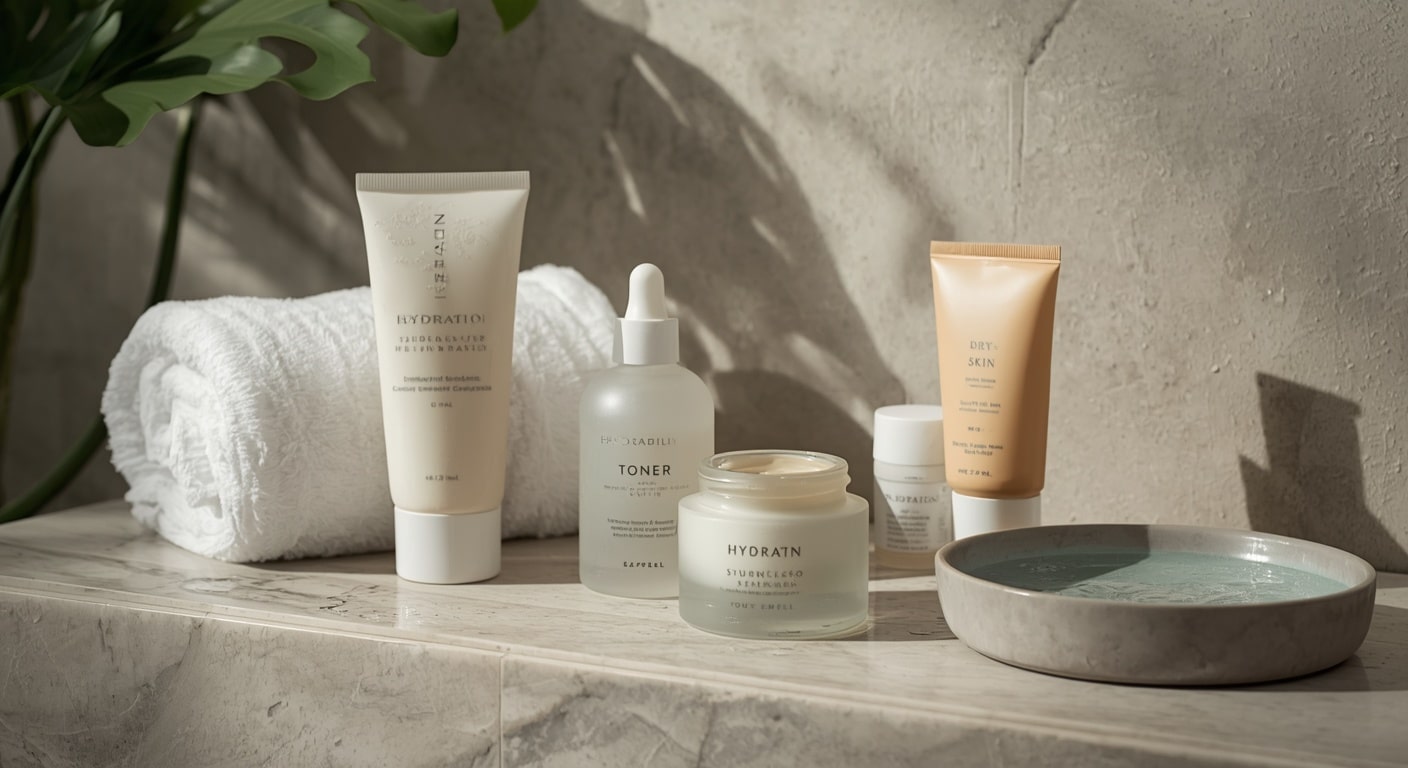
A good skincare routine for dry skin in Malaysia should do four things consistently: cleanse gently, add hydration, lock in moisture and protect the skin during the day. Even in a hot and humid climate, dry skin can still feel tight, rough or uncomfortable, especially if you spend a lot of time in air-conditioned spaces, wash your face too often or use products that strip the skin.
For a broader foundation on building healthy habits, you can also explore our skincare guide for Malaysians.
A simple dry-skin routine in Malaysia usually works best when it focuses on a gentle cleanser, hydrating layers, a barrier-supporting moisturiser and daily broad-spectrum sunscreen. At night, repeat gentle cleansing and use richer hydration if your skin still feels dry. Humid weather does not always prevent dryness, so light but nourishing textures are often more comfortable than very heavy daytime products.
What is the best skincare routine for dry skin in Malaysia?
If you want a practical routine you can start with straight away, keep it simple.
Morning routine: cleanse, hydrate, moisturise and protect
- Use a gentle cleanser if your skin feels oily, sweaty or has overnight product residue. If your skin is very dry, some people prefer a very light cleanse or a splash of lukewarm water in the morning.
- Apply a hydrating toner, essence or serum to add water back into the skin.
- Use a moisturiser to support the skin barrier and reduce moisture loss.
- Finish with broad-spectrum sunscreen every day, even if you spend most of your time indoors near windows or moving between indoors and outdoors.
Night routine: cleanse gently and replenish moisture
- Cleanse gently to remove sunscreen, makeup and the day’s buildup.
- Apply hydrating layers if your skin feels tight or dehydrated.
- Use a moisturiser that feels comfortable and protective.
- Add an optional richer layer only if you still wake up feeling dry.
This is the best place to start for most people. You do not need a long routine for dry skin, and adding too many actives at once can make things worse rather than better.
Why dry skin can still be a problem in Malaysia’s climate
Humidity does not always prevent dryness
Malaysia’s weather is often warm and humid, but that does not mean dry skin disappears. Skin dryness is not only about the air around you. It is also linked to how much oil your skin naturally produces, how healthy your skin barrier is and how often that barrier is disrupted.
Some people naturally have dry skin year-round. Others notice worsening dryness from habits and environments that steadily pull moisture away from the skin, even when the outdoor air feels humid.
How air conditioning, sun exposure and over-cleansing affect the skin barrier
Dry skin often becomes more noticeable when the skin barrier is weakened. In Malaysia, common triggers include long hours in air-conditioned offices, frequent face washing after sweating, long hot showers and strong sun exposure. Harsh cleansers and overuse of exfoliating acids or retinoid-type products can also leave skin feeling tight, flaky or stingy.
Once the barrier is less comfortable, transepidermal water loss can increase, which means water escapes from the skin more easily. That is why a barrier-supportive routine matters even in a humid country.
Step 1: Use a gentle cleanser that does not strip the skin
Cleansing should remove sweat, sunscreen and daily grime without leaving the skin squeaky, tight or itchy. For dry skin, that stripped feeling is usually a sign that the cleanser is too harsh or that you are cleansing too often.
What to look for in a cleanser for dry skin
A cleanser for dry skin usually feels more comfortable when it has a cream, lotion or low-foam gel texture. Look for formulas described as gentle, hydrating or suitable for dry or sensitive skin. Fragrance-free options may also be worth considering if your skin is easily irritated.
A good cleanser should leave your face feeling clean but not raw. If your skin feels immediately tight after washing, the product may not be a good fit.
What to avoid if your skin feels tight after washing
Try to avoid very harsh foaming cleansers, frequent scrubbing and very hot water. Over-cleansing is also common in hot weather because sweat can make skin feel sticky. But washing repeatedly throughout the day can worsen dryness, especially if you are not following with moisturiser.
In the morning, some people with dry skin do well with a minimal cleanse instead of a full wash. At night, however, properly removing sunscreen and surface buildup is still important.
Step 2: Add hydration with a toner, essence or serum
After cleansing, many people with dry skin benefit from one hydrating layer before moisturiser. This step can make the skin feel more comfortable without necessarily making it feel greasy or heavy.
Helpful hydrating ingredients such as glycerin, hyaluronic acid and panthenol
Ingredients often associated with hydration include glycerin, hyaluronic acid and panthenol. These are commonly used to help attract or hold water in the skin. Depending on the formula, you may also see ingredients that support barrier comfort, such as ceramides.
You do not need all of these in one routine. The main goal is simply to choose one well-formulated hydrating product that layers easily under moisturiser.
How to layer hydration without making skin feel heavy
In Malaysia’s climate, dry skin often feels better with lightweight hydrating layers rather than several thick products stacked together in the daytime. A practical approach is:
- apply your hydrating toner, essence or serum to slightly damp skin
- use one layer first and see how your skin feels
- follow fairly soon with moisturiser to help seal it in
If your skin still feels uncomfortable at night, you can use a slightly richer hydrating serum or repeat a light layer before moisturiser. More product is not always better; comfort is a better guide than volume.
Step 3: Seal in moisture with the right moisturiser
Hydration steps add water, but moisturiser helps keep that hydration from disappearing too quickly. For dry skin, this step is usually essential.
Humectants, emollients and occlusives: what they do
Moisturisers often work through a mix of functions.
- Humectants help draw water into the skin.
- Emollients help soften and smooth the skin surface.
- Occlusive ingredients help reduce moisture loss by forming a more protective layer.
You do not need to memorise ingredient lists in detail, but this basic idea helps when choosing products. Dry skin generally benefits from formulas that do more than just feel watery on application.
Choosing lighter daytime textures and richer night-time textures
Many people prefer a lighter cream or lotion during the day in Malaysia because heavy textures may feel uncomfortable in heat and humidity. At night, a richer cream can be useful if your skin tends to feel rough, flaky or tight by morning.
The right texture depends on your own comfort level. If you avoid moisturiser because thick creams feel too much during the day, look for a lighter but still nourishing formula rather than skipping moisturiser entirely.
If you spend long hours in air conditioning, your skin may also need more support than you expect, even if the weather outside is humid.
Step 4: Wear sunscreen every day
Why dry skin still needs sun protection
Sunscreen is not only for oily skin or beach days. Dry skin still needs daily sun protection because UV exposure can add stress to the skin and can make overall skin comfort harder to maintain. In Malaysia, year-round daylight and regular outdoor exposure make sunscreen a practical daily step.
If your routine already includes hydrating products and moisturiser, sunscreen is the final daytime layer that helps protect the skin while you are out and about.
How to choose a sunscreen that feels comfortable on dry skin
For dry skin, a sunscreen may feel more comfortable if it has a moisturising base or a creamier texture rather than a very drying finish. Broad-spectrum SPF is the key starting point. Beyond that, think about wearability: if a sunscreen feels too drying or unpleasant, you may be less likely to use enough of it consistently.
If your sunscreen still feels drying, try adjusting the layer underneath it. A hydrating serum plus a comfortable moisturiser can make sunscreen sit better on the skin.
Optional extras for dry skin
When a facial oil may help
A facial oil can sometimes help if your skin feels dry despite moisturiser, especially at night. It is usually best treated as an optional sealing step rather than a replacement for moisturiser. Oils do not automatically provide everything dry skin needs, but some people find them helpful for added comfort.
If you try one, introduce it simply and use it only where it improves your routine rather than making your skin feel overloaded.
How to use exfoliants carefully without worsening dryness
Exfoliants can be useful in some routines, but dry skin usually needs a careful approach. Over-exfoliating can worsen flaking, increase irritation and weaken the skin barrier further. If you choose to use an exfoliant, keep the rest of your routine gentle and avoid introducing too many active products at the same time.
If your skin is already stinging, cracked or very irritated, it is usually better to simplify and focus on hydration and moisturising first.
When to simplify your routine
If your skin has become reactive, tight or uncomfortable, cutting back can help. A short routine of gentle cleanser, hydrating product, moisturiser and sunscreen is often enough while your skin settles. This also makes it easier to work out whether a specific product is causing problems.
Common mistakes that can make dry skin worse
Over-washing and hot water
Washing your face several times a day, using very hot water or cleansing for too long can strip the skin. In Malaysia, this often happens because people feel the need to remove sweat repeatedly. If your skin is dry, try to distinguish between feeling warm and actually needing a full cleanse.
Using too many active ingredients at once
Layering several acids, exfoliants or strong treatment products together can leave dry skin feeling more irritated than refined. If your main concern is dryness, barrier support usually needs to come before experimentation with multiple active products.
Skipping moisturiser because of humid weather
Humidity does not automatically replace moisturiser. If your skin is dry, skipping moisturiser can leave it more vulnerable to tightness and water loss, especially indoors. The better solution is usually to change texture, not remove the step.
How to tell if your skin is dry or dehydrated
Key differences in how the skin feels and looks
Dry skin is generally a skin type, meaning it naturally produces less oil. It may feel rough, less supple and prone to flaking. Dehydrated skin refers to a lack of water and can happen in many skin types, including oily skin. Dehydrated skin may feel tight, look dull or seem uncomfortable even if the skin still produces oil.
Why the distinction matters when choosing products
This distinction helps when choosing products. Dry skin often needs richer barrier support, while dehydrated skin may respond well to more hydration-focused layers. Some people have both, which is why a routine that combines hydrating products with a suitable moisturiser can be useful.
If your skin feels oily on the surface but tight after washing, dehydration may be part of the picture. If it consistently feels rough and lacks comfort, dryness may be the bigger issue.
When to see a dermatologist
Persistent flaking, cracking, redness or irritation
Some dryness can be managed with a better routine, but persistent flaking, cracking, stinging, redness or irritation may need professional assessment. The same applies if products that should be gentle keep causing discomfort.
When dryness may overlap with a skin condition
Dryness can sometimes overlap with skin conditions rather than being a simple cosmetic issue. If your skin is very inflamed, itchy, painful or not improving despite simplifying your routine, consider seeing a dermatologist or another appropriately qualified healthcare professional. They can help assess whether something more than ordinary dry skin is going on.
Frequently Asked Questions
Can dry skin get worse in Malaysia even though the weather is humid?
Yes. Humidity does not fully prevent dryness. Air conditioning, sun exposure, harsh cleansers, long hot showers and frequent washing can all make dry skin feel worse by weakening the skin barrier and increasing moisture loss.
How many skincare steps does dry skin really need?
Not many. A basic routine can be as simple as a gentle cleanser, one hydrating layer, a moisturiser and sunscreen in the morning, then gentle cleansing and barrier-supportive moisturising again at night.
Should I use a thick moisturiser during the day in Malaysia?
Not necessarily. Many people prefer a lighter but still nourishing moisturiser during the day because it feels more comfortable in heat and humidity. A richer cream may be more suitable at night if your skin still feels dry.
What ingredients are good for dry skin?
Useful categories include humectants such as glycerin and hyaluronic acid, emollients that soften the skin, and barrier-supporting ingredients such as ceramides. The best choice depends on your skin’s comfort and the overall formula, not just one ingredient.
How do I know if my skin is dry or just dehydrated?
Dry skin usually means your skin naturally produces less oil, while dehydrated skin lacks water. You can also have both at the same time. If your skin feels tight, rough or uncomfortable, a routine with hydration plus moisturising support may help.
A simple way to build your routine
If you have dry skin in Malaysia, start with the basics and make comfort your guide. Cleanse gently, add hydration, use a moisturiser that supports your skin barrier and wear sunscreen every day. If the weather makes heavy products uncomfortable, adjust the texture rather than dropping key steps. A routine that feels easy to stick to is usually more helpful than one that looks impressive on paper.